The jet engine: how it is built, how it makes thrust and who invented it
A jet engine makes thrust by throwing a stream of gas backwards: the more air it moves and the faster it leaves, the harder the engine pushes the aircraft forward. Below is how a modern turbofan is built, what happens to the air at each step, where thrust comes from, how a turbofan differs from a turbojet, and who invented the jet engine, all on a 3D model from M2 that you can take apart with your hands.
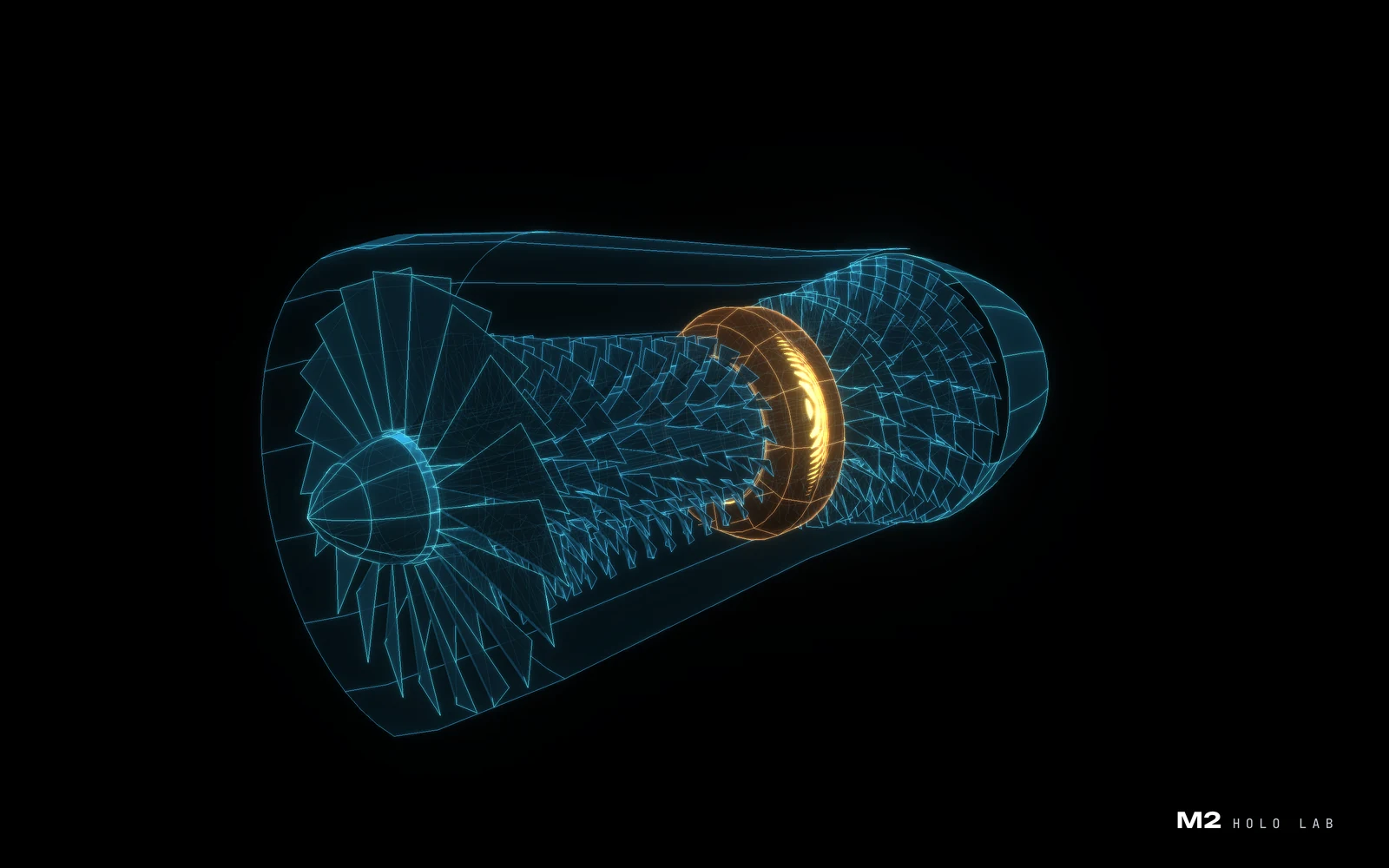
What a jet engine is
A jet engine speeds up a mass of gas and throws it backwards. By Newton's third law the jet pushes the engine forward with an equal force: that is jet thrust. It is the same push as a rifle's recoil, or a balloon zipping around the room as it deflates.
NASA writes the thrust of a turbojet as F = ṁ · ve − ṁ · v0, where ṁ is the mass of air passing through the engine each second, ve is the exit velocity of the jet and v0 is the free-stream velocity. You can raise thrust in two ways: make the jet faster or move more air. The second is more efficient, and modern airliner engines are built around it.
Jet engines are internal combustion engines too, except the fuel burns with a steady, continuous flame rather than in bursts, as in a piston engine.
Types of jet engines
- Rocket: carries both fuel and oxidizer, so it works in space, where there is no air.
- Air-breathing engines take oxygen from the air. There are several kinds:
- ramjet: no compressor or turbine; the air is compressed by forward speed, so it only works at high speed;
- pulsejet: burns fuel in bursts rather than continuously; simple, but noisy and inefficient;
- turbojet: all the air goes through the compressor, combustor and turbine;
- turbofan: a turbojet with a large fan in front that sends part of the air around the core. It is the main type of engine on airliners;
- turboprop: a gas turbine that drives a propeller.
Parts of a turbofan engine
Air flows straight through the engine, front to back, and meets one part after another along the way.
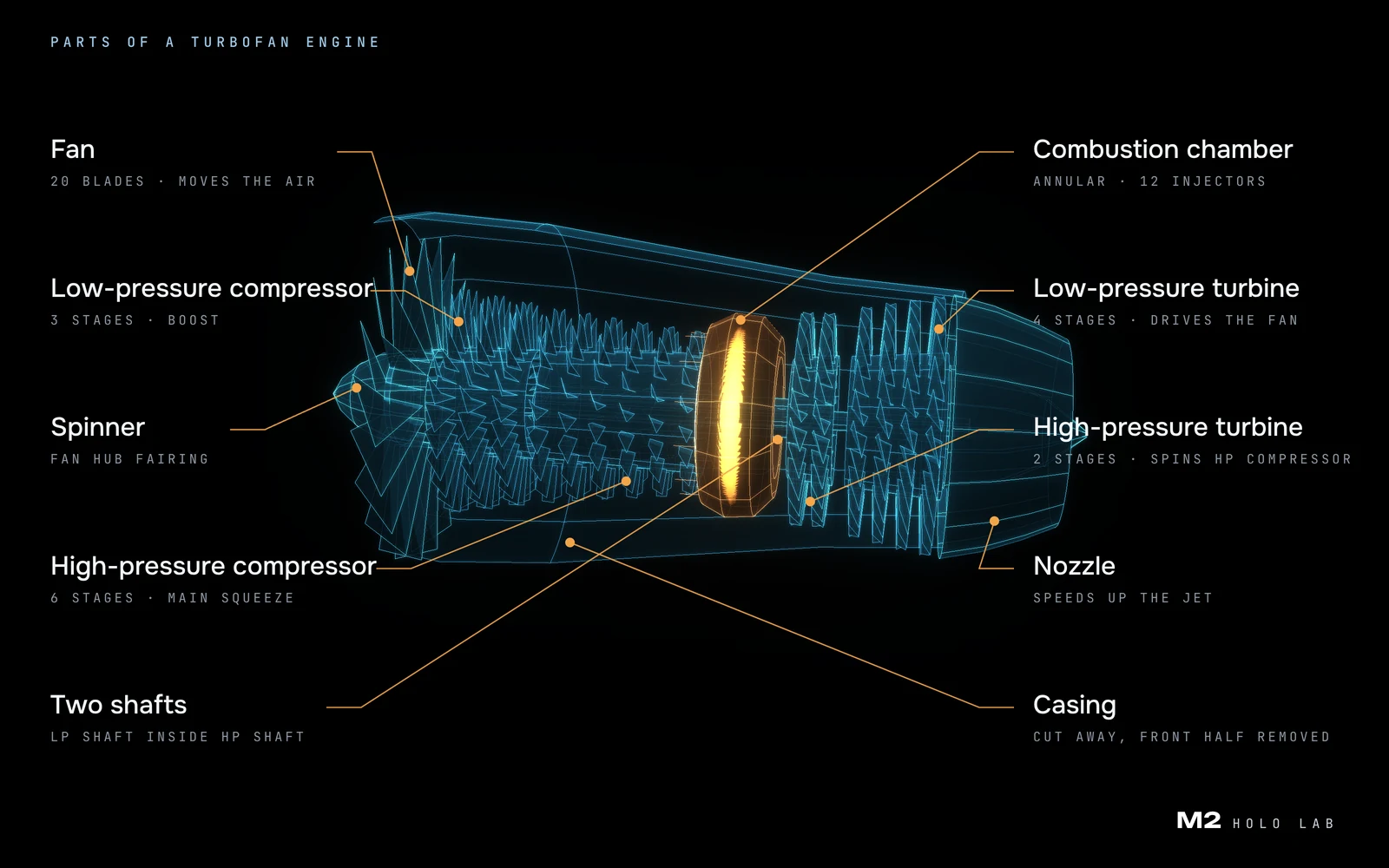
- Fan: the first and largest stage. In the M2 model it has 20 blades. Most of its air goes around the core and gives most of the thrust.
- Spinner: the fairing on the fan hub that guides air smoothly to the blade roots.
- Low-pressure compressor (booster stages): squeezes the air a little before the main compressor. The model has 3 stages.
- High-pressure compressor: the main squeeze, raising the pressure stage by stage. The model has 6 stages. Modern engines reach an overall pressure ratio of 30–60.
- Combustion chamber: injectors spray fuel into the compressed air, and the mixture burns continuously. The model's chamber is annular, with 12 injectors.
- High-pressure turbine: takes the hottest gas first and drives the high-pressure compressor. The model has 2 stages.
- Low-pressure turbine: extracts the rest of the gas's energy and drives the fan and low-pressure compressor. The model has 4 stages.
- Nozzle: with its central cone, speeds up the exhaust and shapes the jet.
- Two shafts, one inside the other, turning at different speeds: the inner one links the low-pressure turbine to the fan, the outer one links the high-pressure turbine to the high-pressure compressor.
How it works: five steps
The air goes through the same steps as in a piston engine: intake, compression, combustion and exhaust. The difference is that a piston engine runs its strokes one after another in the same cylinder, while a jet engine does every step at once, each in its own part of the engine.
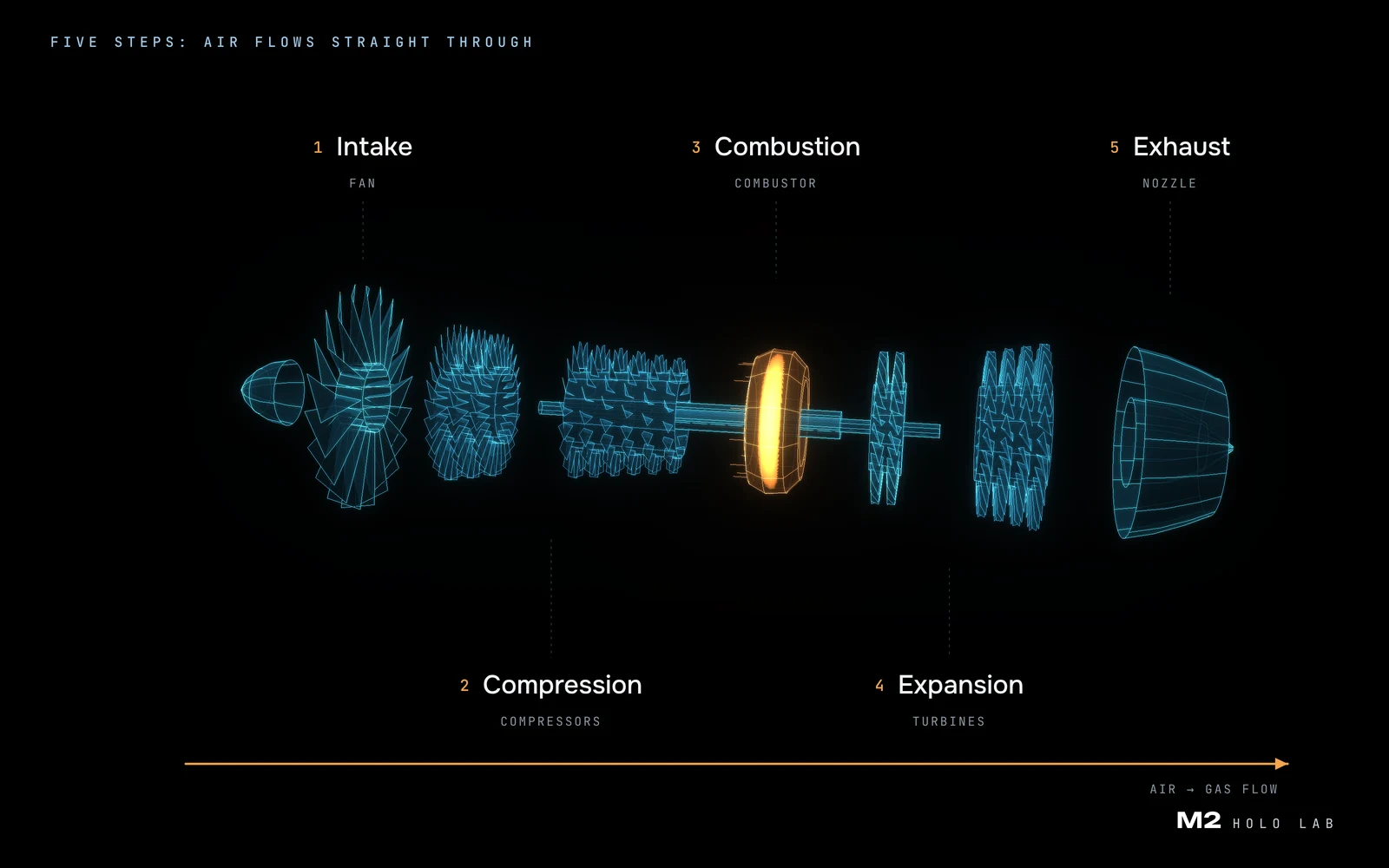
- Intake. The fan draws air into the engine.
- Compression. The low- and high-pressure compressors squeeze the air dozens of times over, and it heats up strongly.
- Combustion. Fuel is injected into the compressed air in the combustion chamber. The mixture burns, and the gas heats up and expands sharply.
- Expansion. The hot gas flows through the turbines and spins them. Through the shafts, the turbines drive the compressor and fan, so the engine feeds itself with air. The gas here is hotter than the blade metal could survive uncooled, so the blades are made of heat-resistant nickel alloys and cooled by air through channels inside them.
- Exhaust. The gas's remaining energy speeds it up in the nozzle, and the jet shoots out backwards.
Turbojet vs turbofan
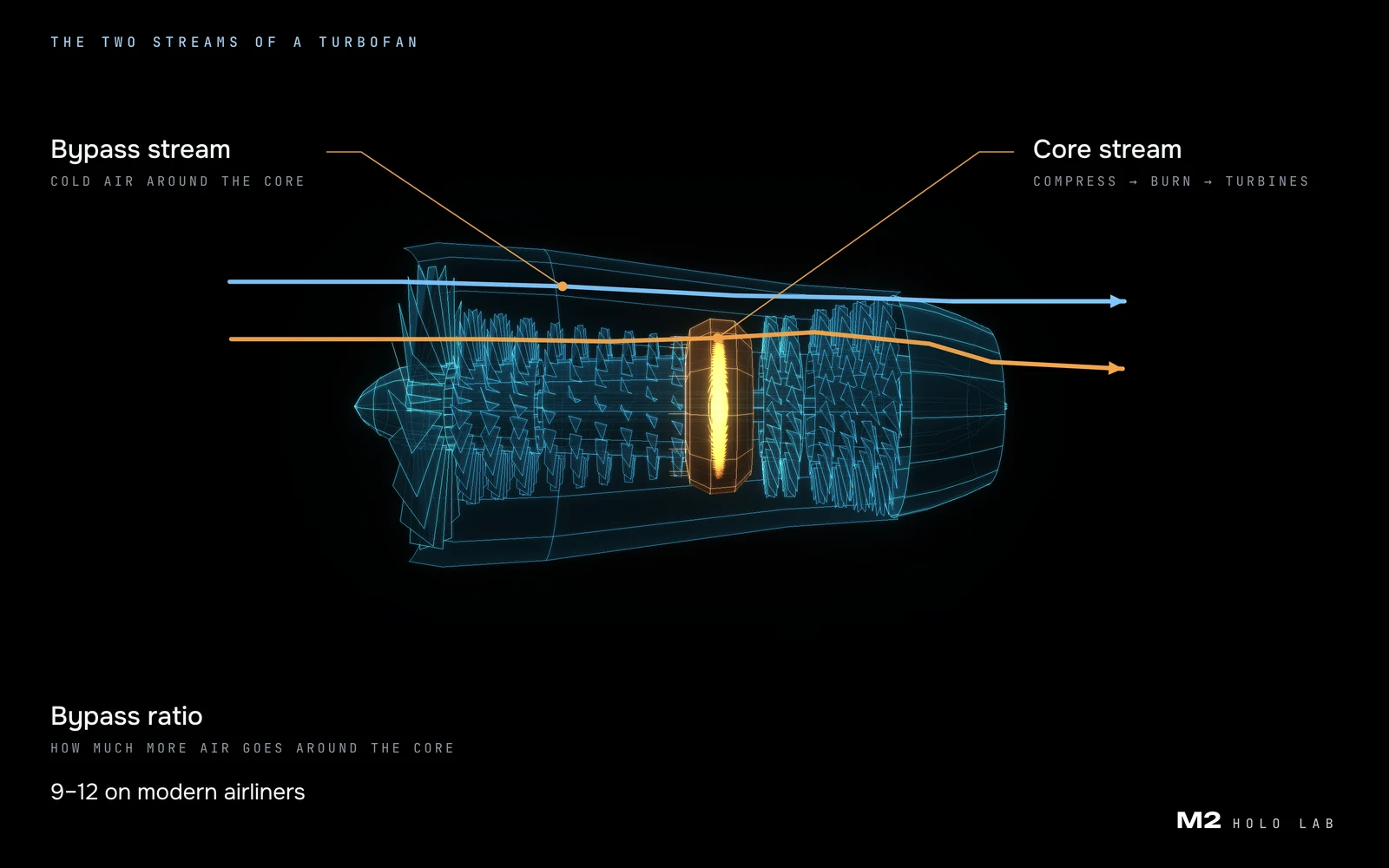
In a turbojet all the air goes through the core: compressor, combustor and turbine. In a turbofan a large fan splits the flow into two streams. The core stream goes through the core, and the bypass stream goes around it, cold.
The bypass ratio tells you how many times more air goes around the core than through it. On modern airliner engines it is about 9–12: around 9 on the GE90, up to 12.5 on the Pratt & Whitney PW1000G.
| Turbojet | Turbofan | |
|---|---|---|
| Where the air goes | all through the core | mostly around the core |
| Jet speed | very high | lower, but more air |
| Fuel efficiency | lower | higher |
| Noise | louder | quieter |
| Used on | supersonic aircraft | airliners |
Why the turbofan is more efficient: it speeds up a lot of air a little, rather than a little air a lot. The thrust is the same, but it burns less fuel. In high-bypass engines most of the thrust comes from the fan.
Jet engine thrust
Thrust is measured in kilonewtons (kN) or pounds-force (lbf). One of the most powerful engines ever built is the GE90-115B for the Boeing 777. It is rated at 513 kN (115,300 lbf), and in a 2003 test it set a record of 569 kN. Its fan is 3.3 m across.
Jet fuel
Jet engines run on aviation kerosene, a mixture of hydrocarbons with about 8 to 16 carbon atoms per molecule.
| Grade | Where it is used | Freezing point |
|---|---|---|
| Jet A-1 | most of the world | −47 °C |
| Jet A | mainly the US | −40 °C |
| TS-1 (GOST 10227) | Russia and the CIS | below −50 °C |
A low freezing point matters: at cruising altitude the air outside can be −50 °C or colder.
Who invented the jet engine
The aircraft jet engine was invented independently in Britain and Germany.
| Year | Milestone |
|---|---|
| 1903 | Konstantin Tsiolkovsky publishes The Exploration of Cosmic Space by Means of Reaction Devices, working out rockets for spaceflight. |
| 1930 | Frank Whittle files a patent for the turbojet on 16 January. In 1936 he also files a patent for a design with a fan. |
| 1937 | Whittle's engine first runs on 12 April. By September, Hans von Ohain's engine is running in Germany. |
| 1939 | On 27 August the Heinkel He 178, powered by von Ohain's engine, flies: the world's first jet aircraft. |
| 1941 | On 15 May the British Gloster E.28/39 flies with Whittle's engine. |
| 1944 | The first jet fighters enter service: the Messerschmitt Me 262 in April and the Gloster Meteor in July. |
How we built this model
The turbofan in M2 was not downloaded ready-made: we built it in code, part by part, from bodies of revolution and rings of blades. Every part is defined by its dimensions and its number of stages and blades.
- Stages. A fan with 20 blades, 3 low-pressure and 6 high-pressure compressor stages, 2 high-pressure and 4 low-pressure turbine stages. The blades are twisted, more at the tip than at the root, as in real engines.
- Two shafts. Each part knows which shaft turns it: the fan, low-pressure compressor and low-pressure turbine sit on the inner shaft, the high-pressure compressor and turbine on the outer one.
- Simplifications. The blades are flat plates rather than true airfoils, and there is no inner cowl separating the bypass duct from the core, as there is in a real engine. That is why the flow lines in the two-stream picture are drawn over the model.
- For this article. In the app the casing comes apart into top and bottom halves; for the illustrations we split it into front and back and lit the flame in the combustion chamber.
Studying a jet engine in 3D
In M2 the engine floats in front of you. Spread your hands and it comes apart along its axis, with every part labelled. You can pull a part out, turn it and put it back.
In assembly mode the parts lie on a workbench, and the place of each one glows as an outline. The order is the same as in a real workshop: shaft, compressors, combustion chamber, turbines, nozzle, then the fan, spinner and casing. Fit a part too early and M2 returns it to the bench and explains what goes first. It runs in the browser with an ordinary webcam, no VR headset needed.
Questions and answers
How does a jet engine work?
It draws in air, squeezes it with a compressor, burns fuel in it and throws the hot gas backwards through a nozzle. On the way the gas spins a turbine that drives the compressor. The jet pushes the engine forward: that is jet thrust.
What is the difference between a turbojet and a turbofan?
In a turbojet all the air goes through the core. In a turbofan a large fan sends most of the air around the core, which makes it more efficient and quieter. Airliners use turbofans.
Why doesn't a jet engine work in a vacuum?
An air-breathing jet engine needs oxygen from the air to burn its fuel, and the air itself as the working fluid. Only a rocket engine works in a vacuum, because it carries its own oxidizer.
What fuel do jet engines use?
Aviation kerosene: Jet A-1 in most of the world, Jet A mainly in the US, and TS-1 (GOST 10227) in Russia and the CIS.
Who invented the jet engine?
Frank Whittle in Britain and Hans von Ohain in Germany, independently. Whittle patented the turbojet in 1930, and the world's first jet aircraft was the He 178 with von Ohain's engine in 1939.
Sources
- NASA Glenn Research Center: Turbojet Thrust
- Britannica: Internal-combustion engine
- Wikipedia: Jet engine
- Wikipedia: Turbofan
- Wikipedia: Frank Whittle
- Wikipedia: General Electric GE90
- Wikipedia: Jet fuel
- Wikipedia: Konstantin Tsiolkovsky
Illustrations are rendered from the M2 turbofan model. Facts are checked against the sources listed below. The model is simplified: flat blades, and no cowl shown between the two streams.