The internal combustion engine: parts, four strokes and who invented it
An internal combustion engine turns the energy in fuel into motion: the fuel burns inside the cylinder, and the hot gases push a piston. Below is how the engine is built, what happens in each of the four strokes, what TDC, BDC and compression ratio mean, how a diesel differs from a petrol engine, and who invented it, all on a 3D model of a single-cylinder engine.
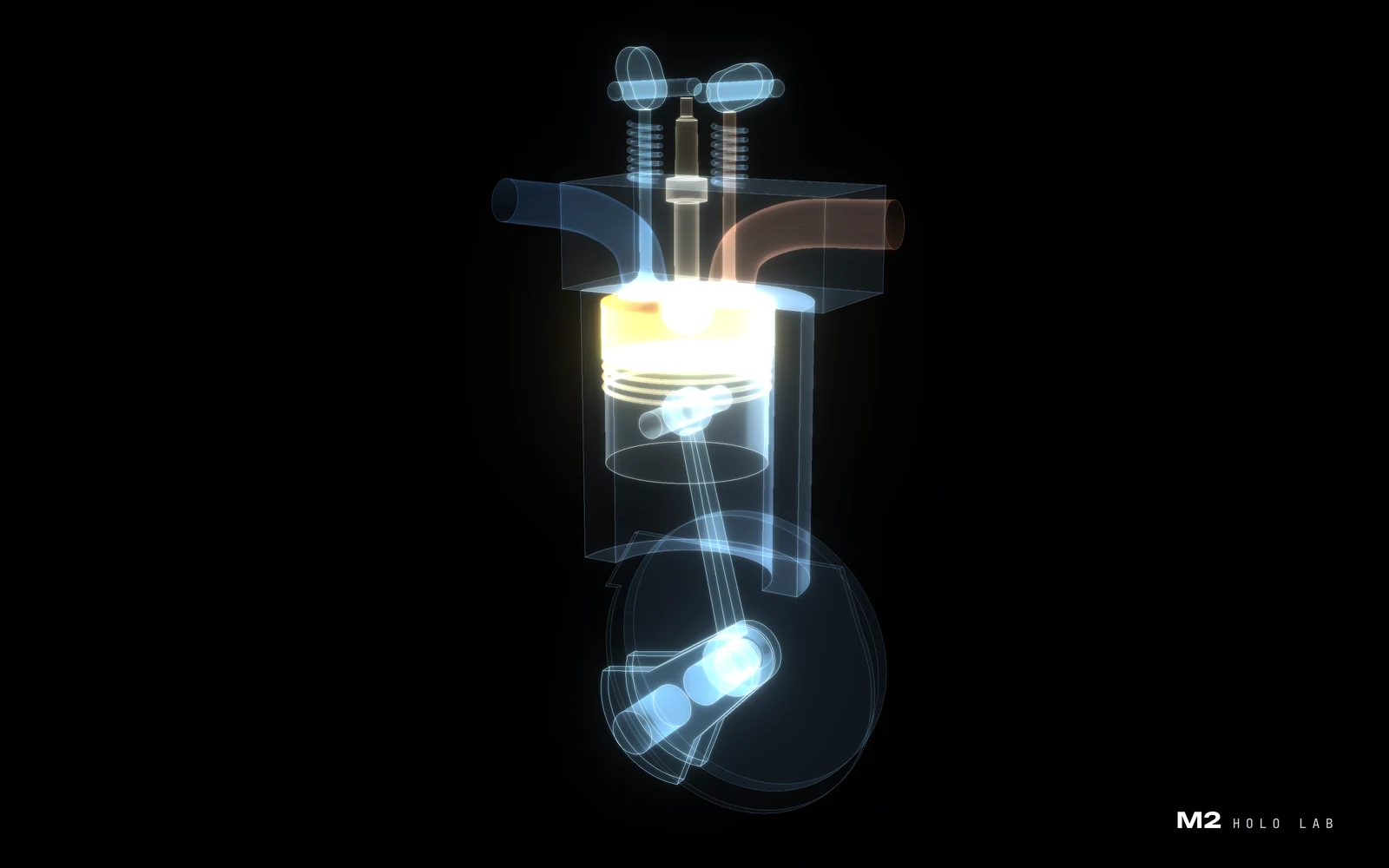
What an internal combustion engine is
A heat engine takes energy from burning fuel and turns it into mechanical work. In a steam engine the fuel burns outside, in a firebox, and heats water in a boiler: that is external combustion. In an internal combustion engine the fuel burns inside the engine itself, and the combustion gases are the working fluid.
Jet engines and gas turbines are internal combustion engines too, but there the fuel burns continuously with a steady flame. Usually the term means a piston engine, where the mixture ignites in bursts inside cylinders. The most common kind is the four-stroke petrol engine with spark ignition, and that is the one described here.
Parts of an engine
At its heart is a cylinder with a piston sliding inside. The top of the cylinder is closed by the head with the valves and spark plug; at the bottom, the piston is linked to the crankshaft by a connecting rod.
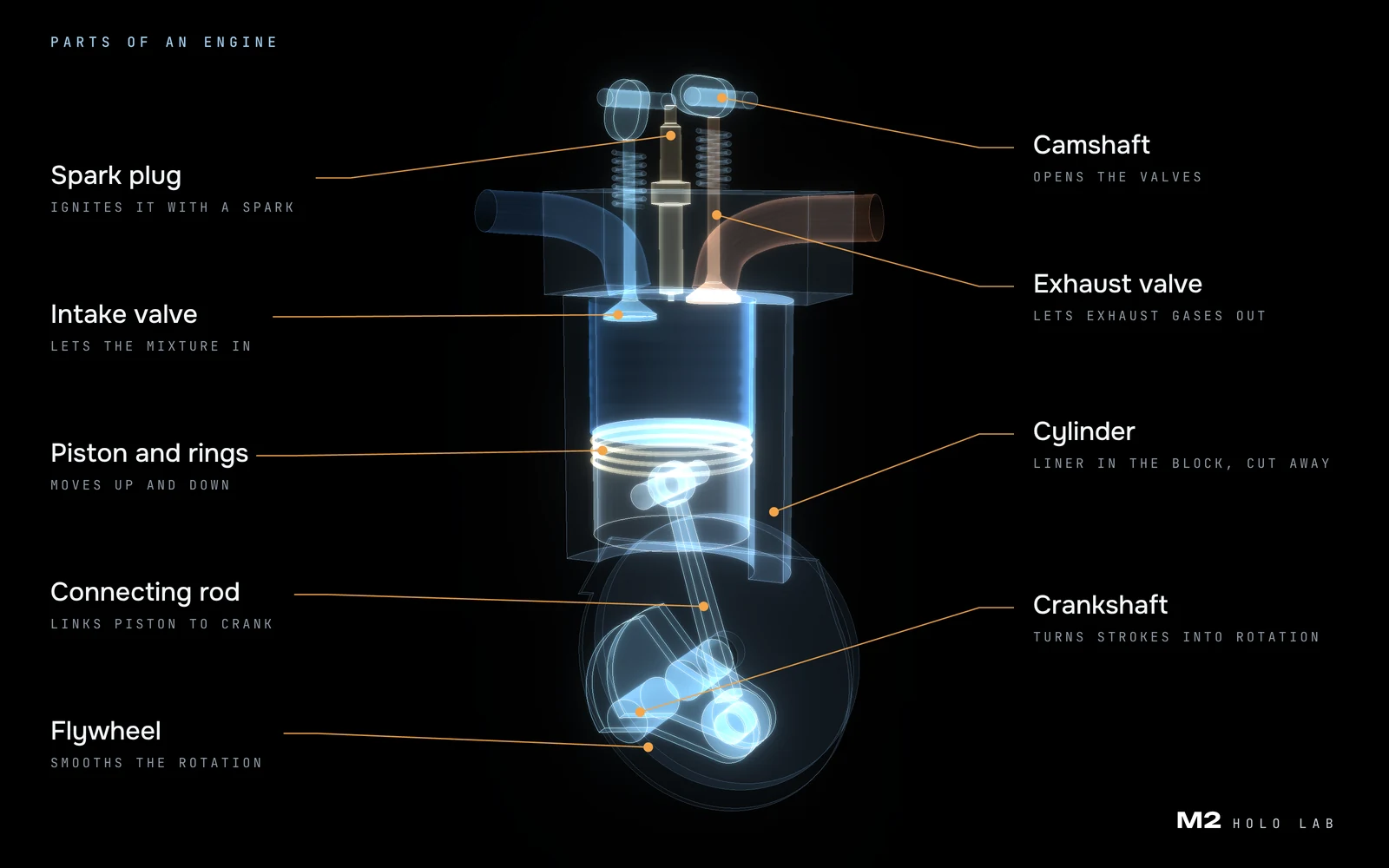
- Cylinder: a smooth bore in the engine block where the mixture burns and the piston moves.
- Piston: takes the pressure of the gases. The piston rings stop the gases from leaking down into the crankcase.
- Connecting rod: a hinged link between the piston and the crankshaft.
- Crankshaft: turns the up-and-down motion of the piston into rotation. Its crank throw moves in a circle while the rod swings.
- Flywheel: a heavy disc on the crankshaft. It stores energy from the power stroke and carries the shaft through the other strokes.
- Intake valve lets the fuel-air mixture in; the exhaust valve lets the burnt gases out.
- Camshaft: its lobes open the valves at the right moment, and springs close them.
- Spark plug: fires a spark at the right moment to ignite the compressed mixture.
Around these parts the engine has its systems: fuel supply, ignition, lubrication, cooling and starting.
The four strokes
A stroke is one movement of the piston from one end of the cylinder to the other. A four-stroke engine completes its cycle in four strokes, which is two turns of the crankshaft, or 720°.
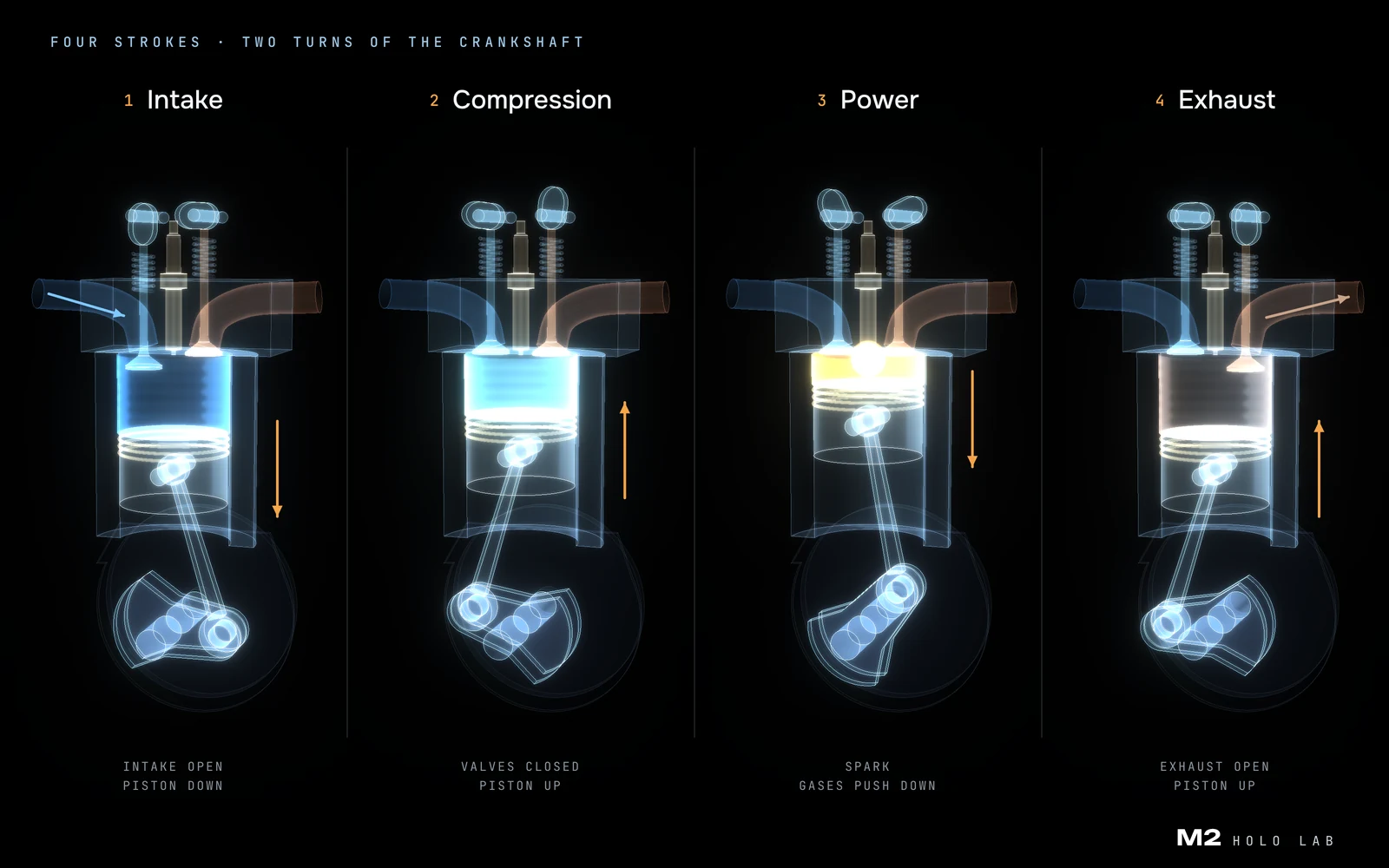
- Intake. The piston moves down with the intake valve open, drawing in a mixture of air and petrol vapour.
- Compression. Both valves are closed and the piston moves up, squeezing the mixture. At the end of the stroke a spark ignites it.
- Power. The mixture burns, the gas pressure jumps and pushes the piston down. The valves stay closed. This is the only stroke that does useful work.
- Exhaust. The piston moves up with the exhaust valve open and pushes the burnt gases out. Then the cycle starts again.
The camshaft turns at half the crankshaft speed: one turn for every two turns of the crank, opening each valve once. The engine gets through three of the four strokes on the momentum of the flywheel. That is why most engines have several cylinders: their power strokes take turns, and the shaft turns more smoothly.
TDC, BDC, displacement and compression ratio
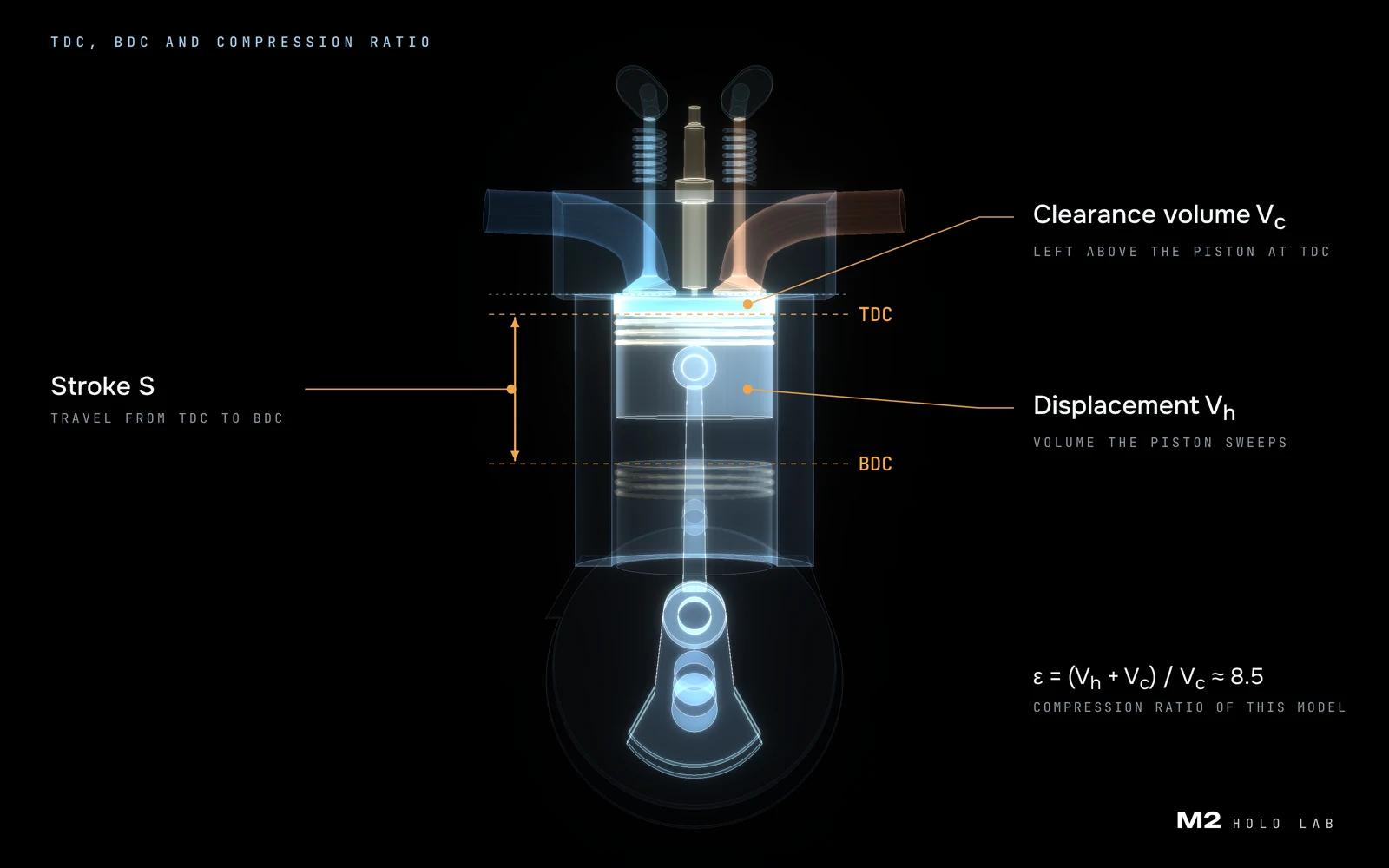
- Top dead centre (TDC) is the piston's highest position, bottom dead centre (BDC) its lowest. At both points the piston stops for an instant and changes direction.
- Stroke S is the distance between TDC and BDC. The piston covers it twice per turn of the crankshaft.
- Clearance volume Vc is the space left above the piston at TDC.
- Displacement Vh is the volume the piston sweeps from TDC to BDC: Vh = π · D² / 4 · S, where D is the bore. Multiply by the number of cylinders for the engine's total displacement.
Example: a four-cylinder engine with an 80 mm bore and an 80 mm stroke has about 0.4 L per cylinder, about 1.6 L in total.
The compression ratio ε tells you how much the mixture is squeezed: ε = (Vh + Vc) / Vc, the full cylinder volume at BDC divided by the clearance volume. Higher compression makes an engine more efficient, but a petrol mixture squeezed too hard can ignite by itself before the spark. That is why the octane rating of the fuel limits the compression ratio.
| Engine | Compression ratio |
|---|---|
| Petrol passenger cars, last 20 years | 8–12 |
| High-compression petrol (Toyota, Mazda) | up to 14–16 |
| Direct-injection diesels | 14–23 |
| The model in the pictures | 8.5 |
Petrol vs diesel
Both use the four-stroke cycle, but the fuel ignites differently.
| Petrol | Diesel | |
|---|---|---|
| Drawn in on intake | air-fuel mixture | air only |
| How the fuel ignites | spark from the plug | heat of compressed air: fuel is injected at the end of compression |
| Spark plug | yes | no, an injector instead |
| Compression ratio | 8–12 | 14–23 |
A diesel squeezes the air so hard that it heats above the fuel's ignition point. The high compression also makes it more efficient: up to 43% for car diesels and 45% for truck diesels.
Types of engines
- By fuel: petrol, diesel, gas.
- By cycle: four-stroke and two-stroke. A two-stroke engine completes its cycle in one turn of the shaft, taking in and expelling gas through ports in the cylinder wall while the piston is low. It is simpler and lighter but uses more fuel; you find it in mopeds, chainsaws and outboard motors.
- By cylinder layout: inline, V and boxer (flat), where the cylinders lie opposite each other.
Engine efficiency
Efficiency is the share of the fuel's energy that becomes mechanical work, η = A / Q. The rest leaves as heat, with the exhaust and through the cooling system.
- Lenoir's engine of 1860: about 4%.
- Average in everyday driving: about 18–20%.
- The best small four-stroke engines: about 43%.
- Large two-stroke marine diesels: over 50%.
Who invented the internal combustion engine
There is no single inventor: the engine took almost a century to mature.
| Year | Milestone |
|---|---|
| 1807 | François Isaac de Rivaz builds a hydrogen engine with electric spark ignition and fits it to a vehicle the next year. |
| 1860 | Étienne Lenoir produces a gas engine: about 2 hp and about 4% efficiency, with no compression before ignition. |
| 1876 | Nikolaus Otto and Eugen Langen build a four-stroke engine that compresses the charge before ignition. The cycle is still called the Otto cycle. |
| 1885 | Gottlieb Daimler and Wilhelm Maybach fit a four-stroke engine to the Reitwagen, the first vehicle powered by one. |
| 1886 | Karl Benz produces a car with a four-stroke engine, regarded as the first automobile. |
| 1892–1893 | Rudolf Diesel patents the compression-ignition engine. In 1897 his third prototype reaches 26% efficiency. |
How we made these illustrations
For this article we built our own single-cylinder four-stroke engine in code and rendered it with the same hologram shader and glow as M2. Every part is defined by its dimensions rather than drawn by hand, so everything in the pictures moves the way it would in a real engine.
- Proportions. The bore is 1, the stroke 0.9 and the connecting rod 1.5. We chose the gap above the piston at TDC to give a compression ratio of 8.5, like an ordinary petrol engine.
- Kinematics. The piston position is computed from the crank angle and the rod length, so the piston does not move in a pure sine wave: it travels faster near TDC than near BDC.
- Valves. The camshafts turn at half crank speed, and each lobe holds its valve open for 180° of crank rotation. That is a simplification: real engines open the valves earlier and close them later, and for a while both are open at once.
- Cutaway. The cylinder and head are cut in half, and the charge is tinted by stroke: blue is fresh mixture, orange is combustion, brown is exhaust.
Studying engines in 3D
M2 has a piston engine you assemble with your hands: a two-cylinder boxer with 30 parts. You fit 23 of them yourself in the right order, from the crankcase to the crankshaft, rods, pistons, cylinders and heads, then press Start.
The crankshaft turns, the rods swing, and the camshaft turns at half speed and opens the valves. The casing turns see-through, like an X-ray, a label above each cylinder shows its current stroke, and an orange flash marks the spark. The cylinders fire in turn. It all runs in the browser with an ordinary webcam, no VR headset needed.
Questions and answers
What are the main parts of an internal combustion engine?
The cylinder, the piston and its rings, the connecting rod, the crankshaft and flywheel, the intake and exhaust valves with the camshaft, and the spark plug.
What are the four strokes of an engine?
Intake, compression, power and exhaust. The whole cycle takes two turns of the crankshaft, and only the power stroke does useful work.
What is compression ratio?
The full cylinder volume divided by the clearance volume: ε = (Vh + Vc) / Vc. Petrol car engines usually run 8–12, diesels 14–23.
How is a diesel different from a petrol engine?
A diesel draws in only air and compresses it so hard that the injected fuel ignites by itself, without a spark plug. A petrol engine draws in an air-fuel mixture and ignites it with a spark.
Who invented the internal combustion engine?
No single person. Lenoir's gas engine appeared in 1860, Nikolaus Otto built the four-stroke engine with compression in 1876, and Rudolf Diesel patented the compression-ignition engine in 1892–1893.
Sources
- U.S. Department of Energy: Internal Combustion Engine Basics
- Britannica: Internal-combustion engine
- Britannica: Diesel engine
- Wikipedia: Four-stroke engine
- Wikipedia: Internal combustion engine
- Wikipedia: Diesel engine
- Wikipedia: Compression ratio
- Wikipedia: Engine displacement
Illustrations are rendered from a 3D single-cylinder engine model we built for this article. Facts are checked against the sources listed below. The diagram is simplified: valve timing is shown without valve overlap.