Alkanes: molecular structure, homologous series and isomers
Alkanes are hydrocarbons in which carbon atoms are joined only by single bonds and every other bond is taken by hydrogen. Their general formula is CnH2n+2. Below is the structure of alkanes on 3D molecular models from M2: why methane is a tetrahedron, how a carbon chain is built, and what a homologous series and isomers are.
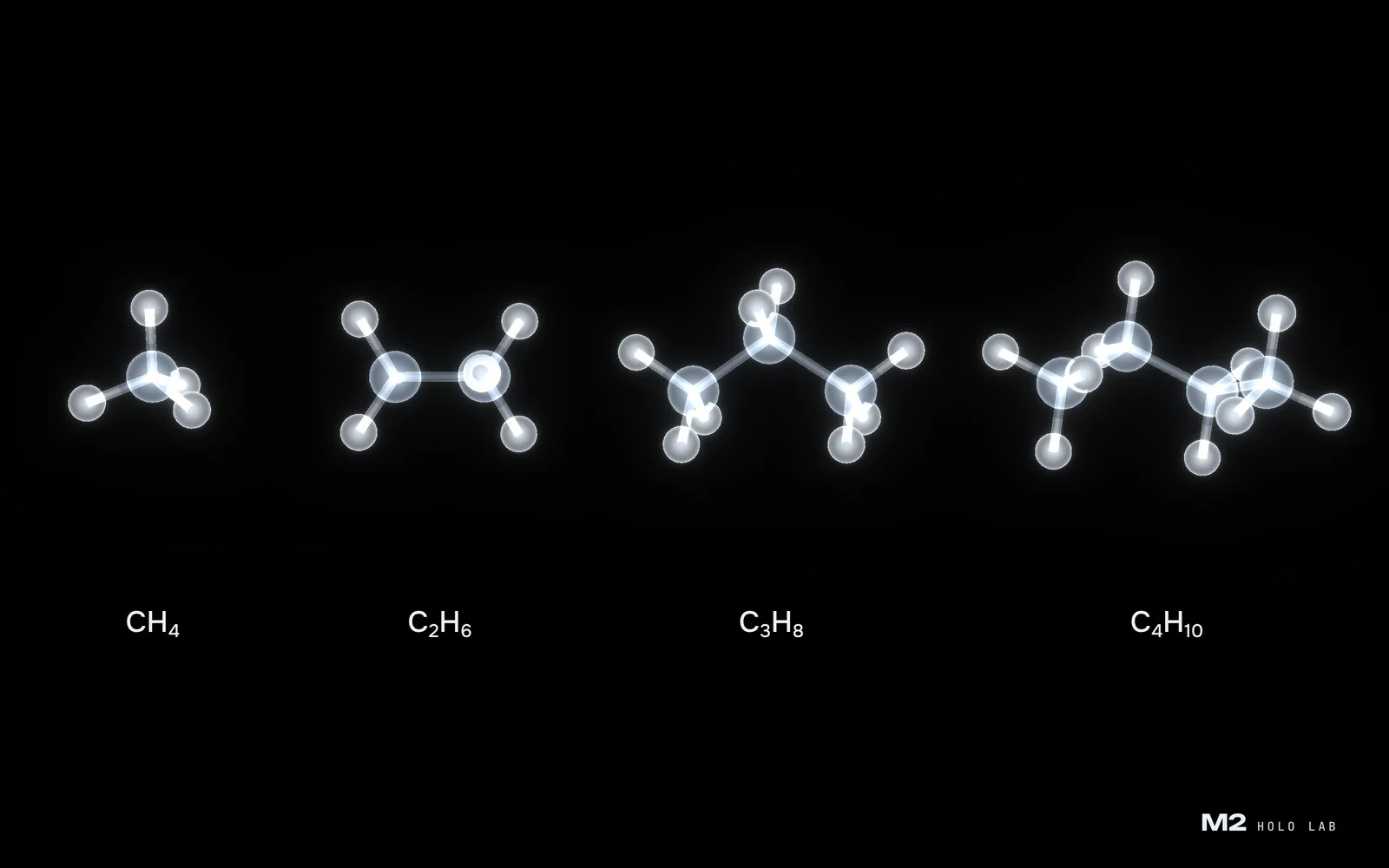
What are alkanes
IUPAC defines alkanes as acyclic hydrocarbons, branched or unbranched, with the general formula CnH2n+2. Every carbon atom in them forms four single bonds, either to other carbon atoms or to hydrogen.
No more hydrogen can be added to such a molecule, because all of carbon's bonds are already taken. That is why alkanes are called saturated hydrocarbons. Their older name is paraffins.
The formula follows from the number of carbon atoms: with n carbons there are 2n + 2 hydrogens. Pentane has five carbons, so its formula is C5H12.
The structure of methane
Methane, CH4, is the simplest alkane. The carbon atom sits at the centre and the four hydrogen atoms at the corners of a regular tetrahedron. All six H–C–H angles are equal at 109.5°, and each C–H bond is 1.09 Å, or 0.109 nm, long.
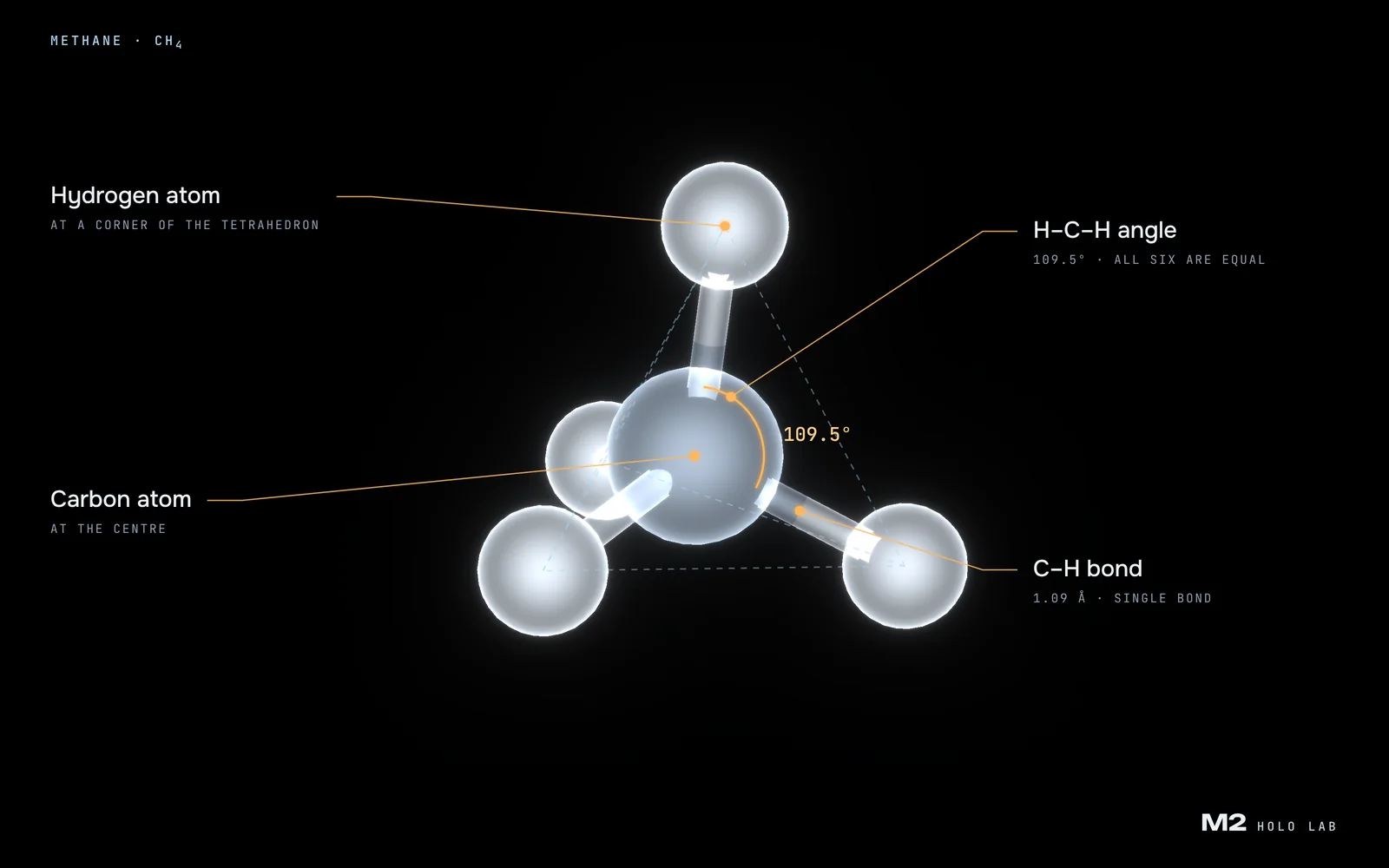
Why a tetrahedron and not a flat cross? The four bonds repel each other and spread out as far as they can. In three dimensions the four directions that are furthest apart point to the corners of a tetrahedron. School courses explain this with sp³ hybridisation: all four bonds of the carbon atom are identical.
So a flat structural formula with bonds drawn at right angles is just a way of writing it down. The real molecule is three-dimensional, and the easiest way to see it is to turn it around.
The carbon chain: ethane, propane, butane
In ethane, C2H6, two carbon atoms are joined by a C–C bond about 1.53 Å long, and each carries three more hydrogens. The bonds of every carbon atom still point to the corners of a tetrahedron.
That is why a carbon chain is not straight but bent: the C–C–C angle is close to the tetrahedral one. In the M2 propane model it is about 112°.
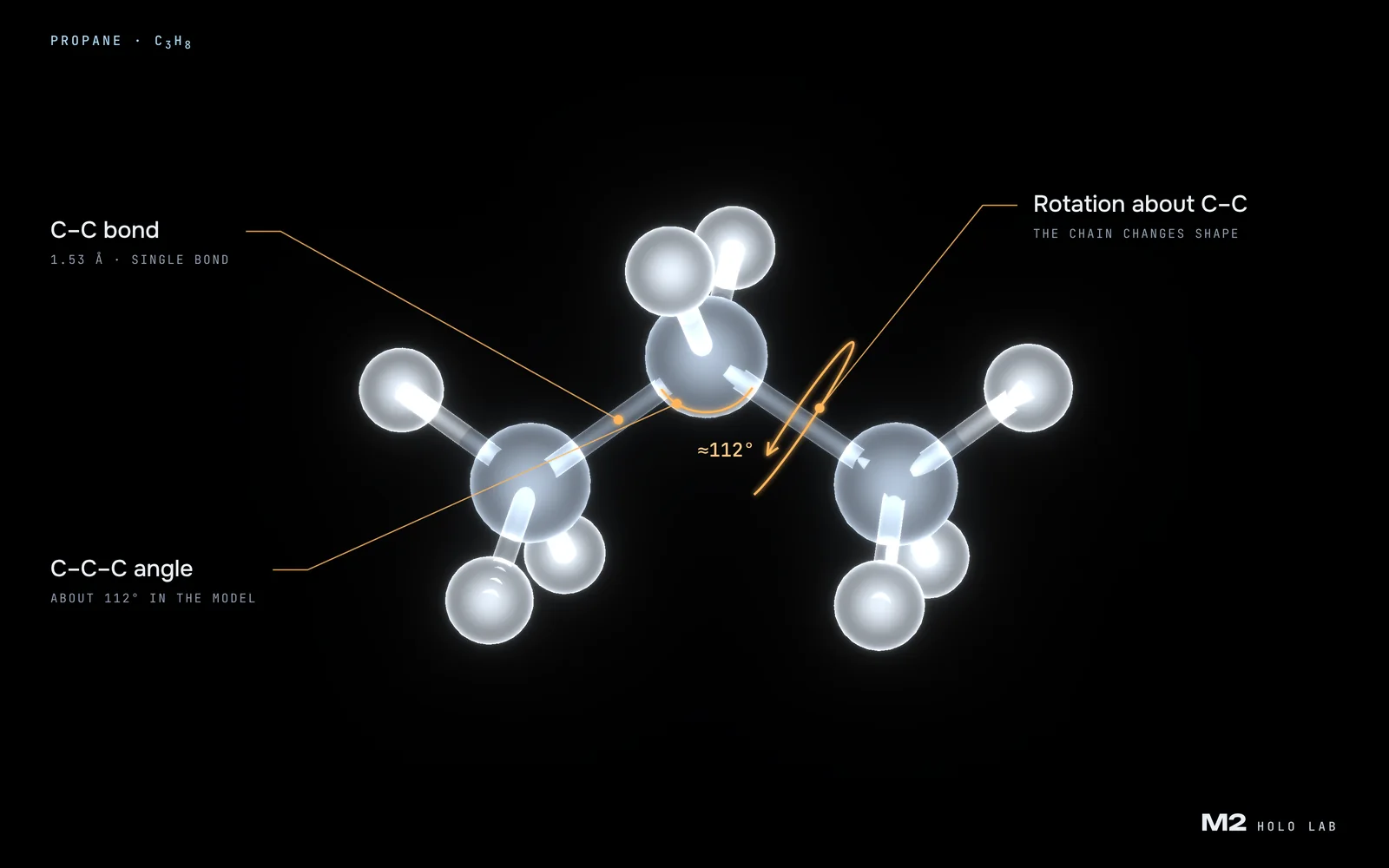
Parts of the molecule can rotate around a single C–C bond as if on an axle. So the same molecule can take different shapes, called conformations. Butane, for example, can be an extended zigzag or a bent form. These are not different substances but one molecule: at room temperature it switches between shapes very quickly.
The homologous series of alkanes
Each alkane is one CH2 group longer than the one before. Such a series is called homologous, and its members are homologues. They are built the same way, so their chemistry is similar, while their physical properties change step by step along the series.
The names of the first four alkanes are historical. From the fifth on, they are built from Greek numbers, penta for five, hexa for six and so on, plus the ending -ane.
| n | Name | Formula | Boiling point, °C | At 20 °C |
|---|---|---|---|---|
| 1 | Methane | CH4 | −162 | gas |
| 2 | Ethane | C2H6 | −89 | gas |
| 3 | Propane | C3H8 | −42 | gas |
| 4 | Butane | C4H10 | ≈ 0 | gas |
| 5 | Pentane | C5H12 | 36 | liquid |
| 6 | Hexane | C6H14 | 69 | liquid |
| 7 | Heptane | C7H16 | 98 | liquid |
| 8 | Octane | C8H18 | 126 | liquid |
| 9 | Nonane | C9H20 | 151 | liquid |
| 10 | Decane | C10H22 | 174 | liquid |
The table shows a pattern: the longer the chain, the higher the boiling point. Larger molecules attract each other more strongly and are harder to pull apart. The first four alkanes are gases at room temperature, C5 to C17 are liquids, and from about C18 on they are solids.
Alkanes do not dissolve in water, and nearly all of them are lighter than it. That is why oil, which is rich in alkanes, spreads over water as a film.
Isomers of alkanes
From butane on, one formula can describe more than one substance. These are called isomers: they contain the same atoms, joined in a different order.
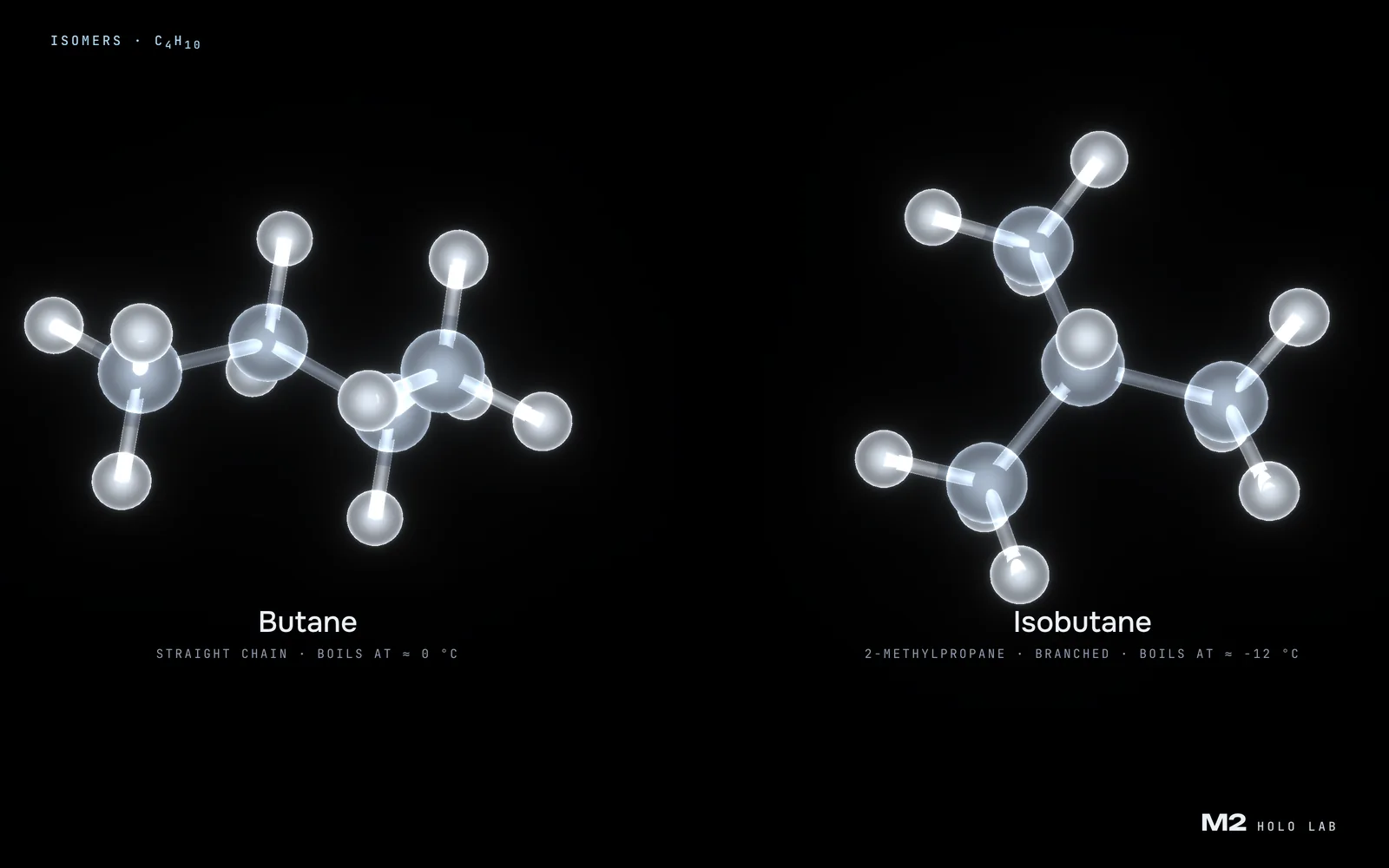
The formula C4H10 has two isomers. In butane (n-butane) the four carbon atoms form one chain. In isobutane, or 2-methylpropane, the central carbon is bonded to three others and the chain branches.
Different structure means different properties. Butane boils at about 0 °C and isobutane at about −12 °C: branched molecules are more compact and attract each other less.
The longer the chain, the more ways there are to branch it:
| Formula | Number of isomers |
|---|---|
| C4H10 | 2 |
| C5H12 | 3 |
| C6H14 | 5 |
| C7H16 | 9 |
| C8H18 | 18 |
| C9H20 | 35 |
| C10H22 | 75 |
| C20H42 | 366 319 |
Pentane, C5H12, for example, has three isomers: pentane, 2-methylbutane and 2,2-dimethylpropane.
How branched alkanes are named
- Find the longest chain of carbon atoms. It gives the base of the name: propane, butane, pentane.
- Number the chain from the end nearest to a branch.
- Before the base, name the branch and the number of the carbon it is attached to: CH3 is methyl, C2H5 is ethyl. If there are several identical branches, add di- or tri-.
Take isobutane. Its longest chain has three carbons, which makes it propane, with a methyl group on the second carbon. That gives 2-methylpropane.
Where alkanes are found
The main natural sources of alkanes are natural gas and oil. Natural gas is mostly methane and ethane, with some propane and butane. Oil is a mixture of liquid alkanes and other hydrocarbons.
Most alkanes are burned as fuel. When methane burns completely it gives carbon dioxide and water: CH4 + 2O2 → CO2 + 2H2O. A mix of propane and butane is the liquefied gas in cylinders, butane fills lighters, and isobutane works as a refrigerant in fridges.
How we built chemistry in M2
We decided from the start that chemistry in M2 would be a library of real substances, not a reaction simulator. A molecule appears when the reactor holds exactly the right atoms, and it snaps straight into its real shape.
Those shapes are not drawn by hand. At first we planned to take ready-made structures from the open PubChem database; in the end we computed them ourselves with the chemistry toolkit RDKit, which places the atoms in space (the ETKDG method) and refines them with the MMFF force field. For the simplest molecules, bond lengths and angles come from reference data, and element data comes from the mendeleev package, which is based on IUPAC data. That is why the models keep real proportions: the 109.5° angle in methane, C–C bonds longer than C–H bonds, a bent propane chain.
What we had to think through along the way:
- Isomers. Since a substance is built from its composition, the atoms alone cannot tell whether you built butane or isobutane: both are C4H10. That is why such formulas have an Other variant button.
- Proportions. Four hydrogens and two oxygens are not a mistake but two water molecules. The set of atoms can be a multiple of the formula.
- An atom in your hand. The first tests ran not with a camera but with simulated hands on a slow machine, at 1–2 frames per second, and there an atom sometimes slipped out of the hand on its way to the reactor. Any substance can also be built without gestures: tap it in the list and the atoms fly out of the table by themselves.
- A bent butane. RDKit computed butane not as an extended zigzag but in one of its bent conformations. That is how M2 shows it, and it is a good reminder that a chain does not have to be straight.
There are limits too: reactions such as burning are not simulated yet, and crystals are shown as a small fragment, simplified for quartz and iron oxide.
How to study alkanes in 3D
In M2 the periodic table floats right in front of you. Pinch a carbon atom, then four hydrogens, and drop them into the reactor ring: the atoms snap into the methane tetrahedron. Ethane, propane, butane and isobutane are built the same way. You can turn the molecule with your hand and open it full screen.
When one formula matches several substances, the Other variant button switches between them: C4H10 is butane or isobutane. In task mode M2 names a substance and you build it yourself; a hint shows the formula. M2 has 86 substances, from hydrogen to caffeine. It runs in the browser with an ordinary webcam, no VR headset.
Questions and answers
What is the general formula of alkanes?
CₙH₂ₙ₊₂, where n is the number of carbon atoms. Pentane, for example, has n = 5, so its formula is C₅H₁₂.
Why are alkanes called saturated?
All bonds of their carbon atoms are single and taken by other carbons or by hydrogen. No more hydrogen can be added: the molecule is saturated.
What is the shape of a methane molecule?
A tetrahedron: carbon at the centre, four hydrogens at the corners. All H–C–H angles are 109.5°, and the C–H bond is 1.09 Å long.
How many isomers does butane have?
Two: straight-chain butane and isobutane, also called 2-methylpropane. Pentane has three isomers, hexane five and decane 75.
Which alkanes are gases?
Methane, ethane, propane and butane are gases at room temperature. Alkanes from C₅ to C₁₇ are liquids, and from about C₁₈ on they are solids.
Sources
- IUPAC Gold Book: alkanes
- Britannica: Hydrocarbon — three-dimensional structures
- LibreTexts: Properties of Alkanes
- NC State University: Alkanes and Alkane Isomers
- NIST Chemistry WebBook: Butane
- NIST Chemistry WebBook: Isobutane
- Wikipedia: Alkane
- Wikipedia: Butane
- Wikipedia: Isobutane
- RDKit: open-source cheminformatics
Illustrations are rendered from the M2 molecules. Facts are checked against the sources listed below. Boiling points in the table are rounded.