Structure of the atom: the nucleus, electron shells and electron configurations
An atom is the smallest particle of a chemical element that keeps its properties. At its centre sits a tiny, heavy nucleus of protons and neutrons, and around it the electrons are arranged in shells. Below is the structure of the atom, part by part, on 3D models from M2: what an atom is made of, how to find the numbers of protons, neutrons and electrons, how electron shells work and how to write an electron configuration.
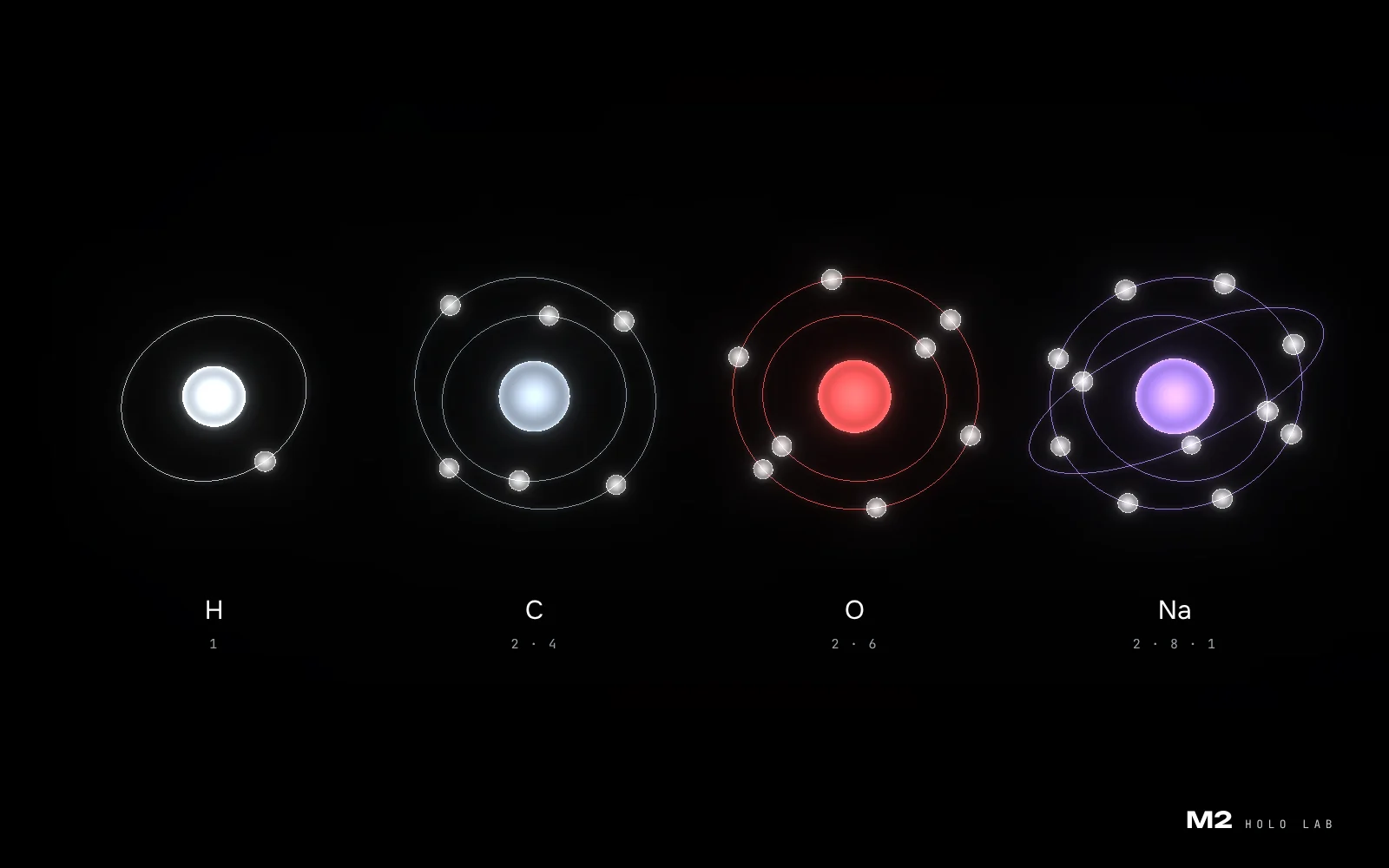
What an atom is made of
An atom consists of a nucleus and electrons. The nucleus is positively charged and the electrons negatively, and overall the atom is electrically neutral: it has as many electrons as there are protons in the nucleus.
| Particle | Charge | Mass, u | Where it is |
|---|---|---|---|
| Proton, p | +1 | 1.007 | in the nucleus |
| Neutron, n | 0 | 1.009 | in the nucleus |
| Electron, e | −1 | 0.000549 (1836 times lighter than a proton) | in shells around the nucleus |
The nucleus is very small. An atom is about 10−10 m across, and its nucleus about 10−15 m, tens of thousands of times smaller. If an atom were the size of a stadium, the nucleus would be a pea in the middle of the pitch. Yet the nucleus holds more than 99.9% of the atom's mass: a proton or neutron is almost 2000 times heavier than an electron.
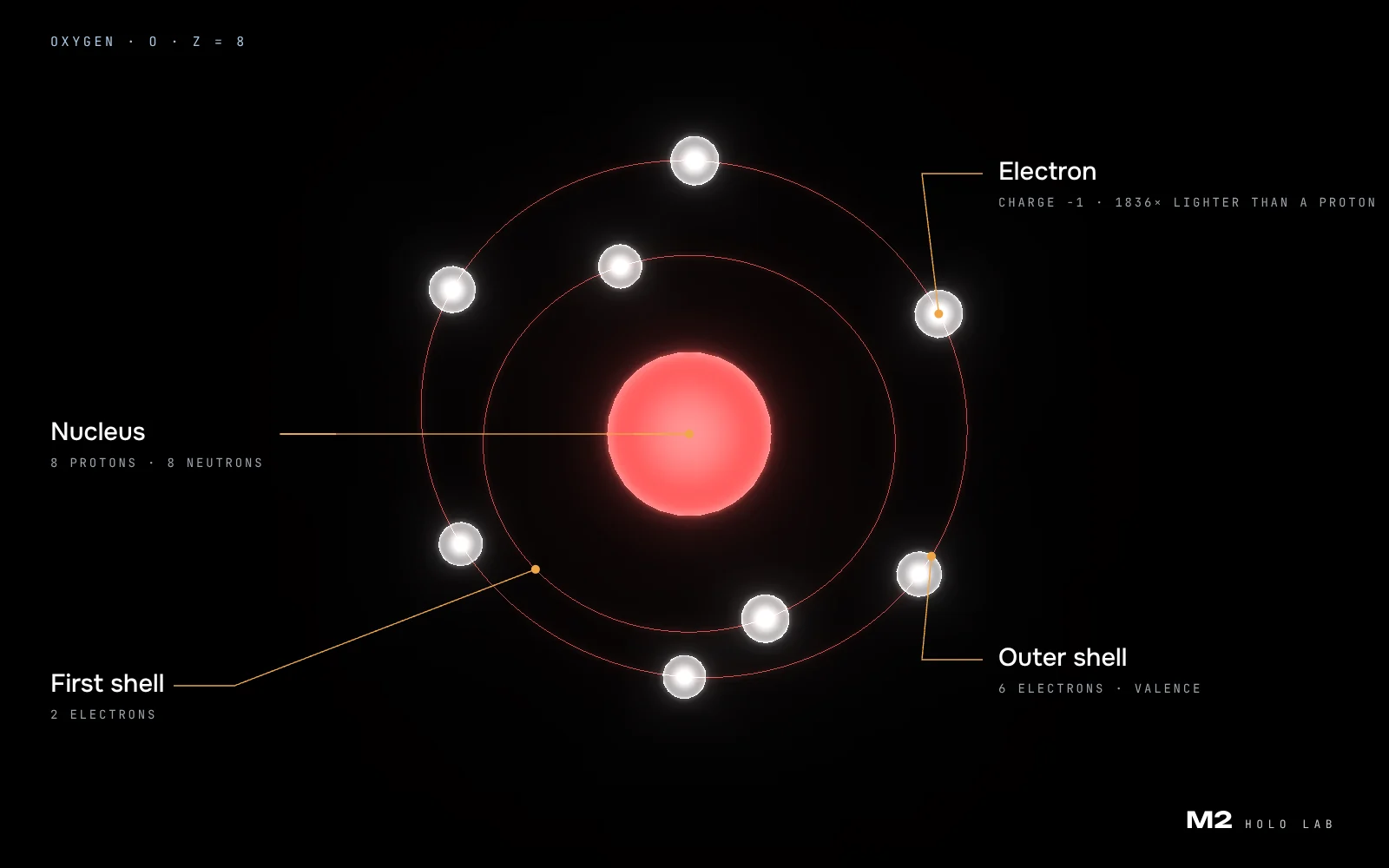
Protons and neutrons together are called nucleons. Protons repel each other, but the nucleus does not fly apart: the nucleons are held together by the strong nuclear force, which at such distances beats the electric repulsion.
Atomic number, mass number and the number of neutrons
You can read an atom's structure from the periodic table. You need two numbers.
- The atomic number Z is the element's number in the table. It equals the number of protons in the nucleus and the charge of the nucleus, and a neutral atom has the same number of electrons. The number of protons is what makes an element what it is: an atom with 8 protons is always oxygen.
- The mass number A is the total of protons and neutrons in the nucleus. It is close to the relative atomic mass rounded to a whole number.
That gives the number of neutrons: N = A − Z.
- Oxygen: Z = 8, A = 16. 8 protons, 8 electrons and 16 − 8 = 8 neutrons.
- Sodium: Z = 11, A = 23. 11 protons, 11 electrons and 23 − 11 = 12 neutrons.
- Chlorine: Z = 17, A = 35 for its most common isotope. 17 protons, 17 electrons and 35 − 17 = 18 neutrons.
Isotopes
Atoms of one element can differ in their number of neutrons. These variants are called isotopes. They have the same number of protons, so they behave almost the same chemically, but their masses differ.
Hydrogen has three isotopes: protium (a nucleus of just a proton), deuterium (a proton and a neutron) and tritium (a proton and two neutrons). The best-known carbon isotopes are carbon-12, with 6 neutrons, and radioactive carbon-14, with 8, which is used to date ancient finds.
That is why atomic masses in the periodic table are not whole numbers. Each is an average over the isotopes, weighted by how common each one is in nature. For chlorine it is 35.45: about three quarters of its atoms are chlorine-35 and the rest chlorine-37.
Electron shells
The electrons in an atom are arranged in energy levels, or electron shells. The further a shell is from the nucleus, the more energy its electrons have and the more loosely they are held. Shells are numbered outwards from the nucleus, 1, 2, 3 and so on, or lettered K, L, M, N.
Each shell has a limit: shell number n holds at most 2n2 electrons. That is 2 in the first, 8 in the second, 18 in the third and 32 in the fourth.
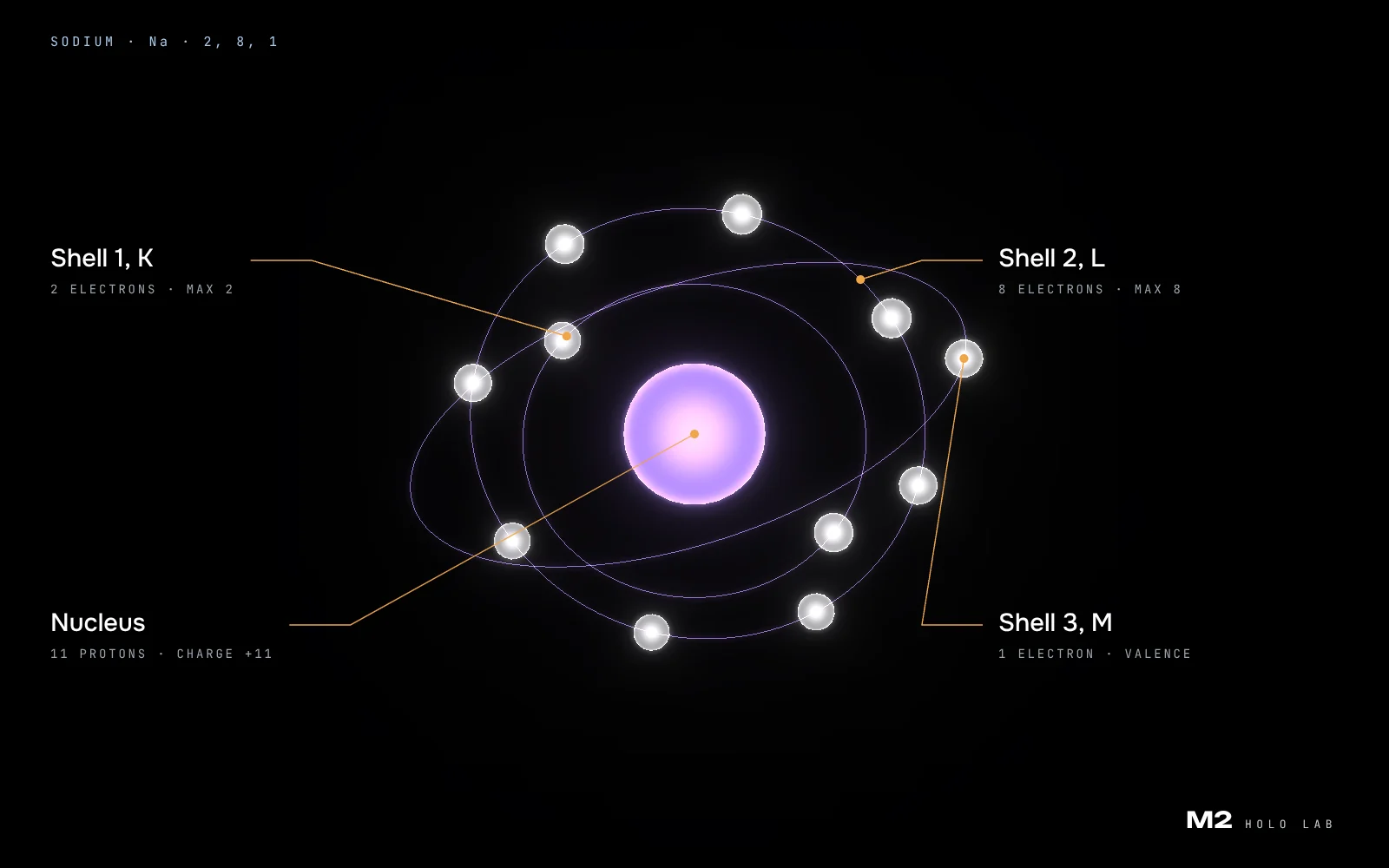
A sodium atom has 11 electrons. Two fill the first shell, eight the second, and the last, the eleventh, goes into the third. The shell diagram of sodium is 2, 8, 1.
The electrons in the outer shell are called valence electrons. They are furthest from the nucleus and most loosely held, so they are the ones that take part in chemical bonds. Sodium gives up its single outer electron easily, which is why it reacts so violently with water.
Electron configuration
Each shell is divided into subshells: s, p, d and f. Subshells are made of orbitals, and each orbital holds at most two electrons.
| Subshell | Orbitals | Max electrons | First appears |
|---|---|---|---|
| s | 1 | 2 | in shell 1 |
| p | 3 | 6 | in shell 2 |
| d | 5 | 10 | in shell 3 |
| f | 7 | 14 | in shell 4 |
An electron configuration shows how many electrons sit in each subshell: the shell number, the subshell letter and the number of electrons as a superscript. Subshells fill in order of rising energy: 1s → 2s → 2p → 3s → 3p → 4s → 3d → 4p.
- Oxygen, 8 electrons: 1s22s22p4. By shell: 2 and 6.
- Sodium, 11 electrons: 1s22s22p63s1. The start is the same as neon, so it is shortened to [Ne]3s1.
- Potassium, 19 electrons: [Ar]4s1. The 4s subshell fills before 3d, so potassium is 2, 8, 8, 1 rather than 2, 8, 9.
Atomic structure of the first three periods
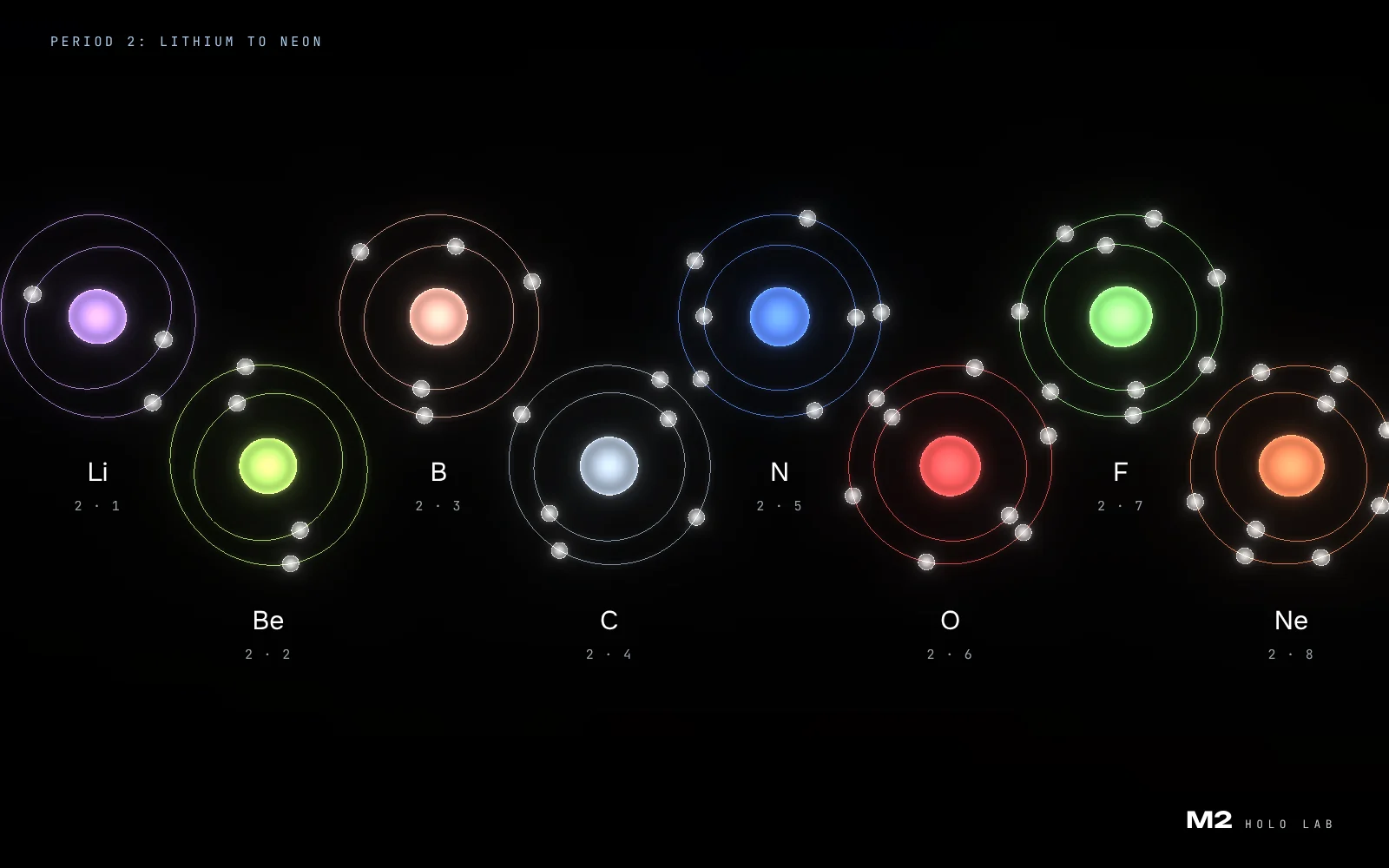
Within a period all atoms have the same number of shells, and the outer shell gains one electron with each element. A period ends with a noble gas, whose outer shell is full.
| Z | Element | p / n / e | Shells | Electron configuration |
|---|---|---|---|---|
| 1 | Hydrogen (H) | 1 / 0 / 1 | 1 | 1s1 |
| 2 | Helium (He) | 2 / 2 / 2 | 2 | 1s2 |
| 3 | Lithium (Li) | 3 / 4 / 3 | 2, 1 | 1s22s1 |
| 4 | Beryllium (Be) | 4 / 5 / 4 | 2, 2 | 1s22s2 |
| 5 | Boron (B) | 5 / 6 / 5 | 2, 3 | 1s22s22p1 |
| 6 | Carbon (C) | 6 / 6 / 6 | 2, 4 | 1s22s22p2 |
| 7 | Nitrogen (N) | 7 / 7 / 7 | 2, 5 | 1s22s22p3 |
| 8 | Oxygen (O) | 8 / 8 / 8 | 2, 6 | 1s22s22p4 |
| 9 | Fluorine (F) | 9 / 10 / 9 | 2, 7 | 1s22s22p5 |
| 10 | Neon (Ne) | 10 / 10 / 10 | 2, 8 | 1s22s22p6 |
| 11 | Sodium (Na) | 11 / 12 / 11 | 2, 8, 1 | [Ne]3s1 |
| 12 | Magnesium (Mg) | 12 / 12 / 12 | 2, 8, 2 | [Ne]3s2 |
| 13 | Aluminium (Al) | 13 / 14 / 13 | 2, 8, 3 | [Ne]3s23p1 |
| 14 | Silicon (Si) | 14 / 14 / 14 | 2, 8, 4 | [Ne]3s23p2 |
| 15 | Phosphorus (P) | 15 / 16 / 15 | 2, 8, 5 | [Ne]3s23p3 |
| 16 | Sulfur (S) | 16 / 16 / 16 | 2, 8, 6 | [Ne]3s23p4 |
| 17 | Chlorine (Cl) | 17 / 18 / 17 | 2, 8, 7 | [Ne]3s23p5 |
| 18 | Argon (Ar) | 18 / 22 / 18 | 2, 8, 8 | [Ne]3s23p6 |
p / n / e are protons, neutrons and electrons. Neutrons are given for the most common isotope.
How atomic structure maps onto the periodic table
- The element's number equals its number of protons and electrons.
- The period number equals the number of electron shells. Sodium is in period 3, so it has three shells.
- The group number of a main-group element tells you how many electrons are in the outer shell. In the 18-column table these are groups 1–2 and 13–18; for groups 13–18 the outer electrons are the group number minus 10. Helium is the exception, with 2.
That explains the chemistry. Metals with 1–3 outer electrons find it easier to give them away, and non-metals with 5–7 to take in the ones missing to make eight. Noble gases already have a full outer shell, so they hardly react at all.
How the model of the atom changed
- 1897–1904, Thomson. Thomson discovers the electron and later proposes the plum pudding model: electrons embedded in a positively charged ball.
- 1909–1911, Rutherford. On his instructions Geiger and Marsden fire alpha particles at a thin gold foil. A few bounce straight back, so the positive charge and almost all the mass must sit in a tiny nucleus. This gives the planetary model.
- 1913, Bohr. Electrons move only in certain allowed orbits and lose no energy while they stay there. The model explains the spectrum of hydrogen.
- 1932, Chadwick. The neutron is discovered, and the make-up of the nucleus becomes clear: protons and neutrons.
- The 1920s, quantum mechanics. Schrödinger and others show that an electron has no exact path. Instead there is an orbital, the region where the electron is most likely to be found, the electron cloud.
The ring diagram used in textbooks, and the one M2 shows, is closest to Bohr's model. It is handy for counting electrons by shell, but real electrons do not circle the nucleus like planets.
How we showed the atom in M2
In M2's chemistry mode an atom appears when you pinch an element out of the periodic table. In your hand is a hologram nucleus with electrons running around it in shells: 2 and 6 for oxygen, 2, 8 and 1 for sodium. The illustrations in this article are rendered with the same code.
The number of electrons in each shell is not typed in by hand: for all 118 elements it comes from the mendeleev package, which is based on IUPAC data. What we had to think through:
- Rings must not merge. Each shell is tilted at its own angle and the radius grows with the shell number, so you can tell the shells apart even in heavy elements.
- Size of the nucleus. The nucleus grows with the element's number as a cube root, roughly the way a real nucleus grows with its number of nucleons. It is of course hugely enlarged, otherwise you could not see it.
- Speed. Inner shells spin faster than outer ones, so the electrons do not blur into one stream.
There are limits too. The protons and neutrons in the nucleus are not shown one by one, the s, p, d and f subshells are not visible, and the electrons move in circles as in Bohr's model, not as a cloud. For the heaviest, superheavy elements the electron arrangement is calculated, not measured.
How to study atomic structure in 3D
In M2 the periodic table of all 118 elements floats right in front of you. Point at a cell and the element's card opens: atomic number, atomic mass, period and group, electrons by shell, state at room temperature and a short fact.
Pinch the cell and the atom is in your hand: you can count the electrons in each shell and compare neighbours in a period. Drop atoms into the reactor ring and they build a real substance, such as water or table salt. It runs in the browser with an ordinary webcam, no VR headset.
Questions and answers
What is an atom made of?
A positively charged nucleus and negatively charged electrons around it. The nucleus is made of protons and neutrons and holds more than 99.9% of the atom's mass.
How do you find the numbers of protons, neutrons and electrons?
There are as many protons and electrons as the atomic number Z. The neutrons are the mass number minus the atomic number: N = A − Z. Oxygen has 8 protons, 8 electrons and 16 − 8 = 8 neutrons.
How many electrons can a shell hold?
At most 2n², where n is the shell number: 2 in the first, 8 in the second, 18 in the third and 32 in the fourth. The outer shell of a main-group element holds no more than 8.
How are the period and group related to atomic structure?
The period number equals the number of electron shells. For main-group elements the group number gives the number of outer electrons: sodium, in group 1 and period 3, has three shells and one outer electron.
What is an electron configuration?
A record of how many electrons sit in each subshell. Oxygen, for example, is 1s²2s²2p⁴: two electrons in 1s, two in 2s and four in 2p.
Sources
- Britannica: Atom
- Britannica: Rutherford model
- Britannica: Bohr model
- NIST CODATA: proton-electron mass ratio
- IUPAC: Periodic Table of Elements
- Wikipedia: Atomic nucleus
- Wikipedia: Electron shell
- Wikipedia: Electron configuration
- Wikipedia: Isotope
- mendeleev: a Python package of element properties
Illustrations are rendered with the same atom as M2's chemistry mode. Facts are checked against the sources listed below. The ring model is simplified, like Bohr's model; the nucleus and shells are not drawn to scale.